
The hidden rules that hold us back
We all carry beliefs that help us, the ones that steady us when life is uncertain and give us courage to try. But alongside them sit other beliefs that quietly shrink the edges of our world. These are the ones that whisper I am too old to change, I will fail if I step out of line, I am not creative, people will laugh if I try. They are rarely shouted. They arrive as background rules, picked up from childhood, culture, workplaces, or past experiences, and because they feel like facts, we rarely challenge them. We simply live inside them as if they were the walls of the house.
A limiting belief can be traced in the hesitation before sending an application, the excuses that rise when you want to speak up, the avoidance of risks that secretly call to you. For one person it might sound like I need to be perfect before I start. For another it is Success is for others, not people like me. For someone else it is If I slow down, I will lose everything. None of these are objectively true, yet the belief makes them feel true, and so we act accordingly. We miss opportunities not because we lack ability but because we cannot imagine another story.
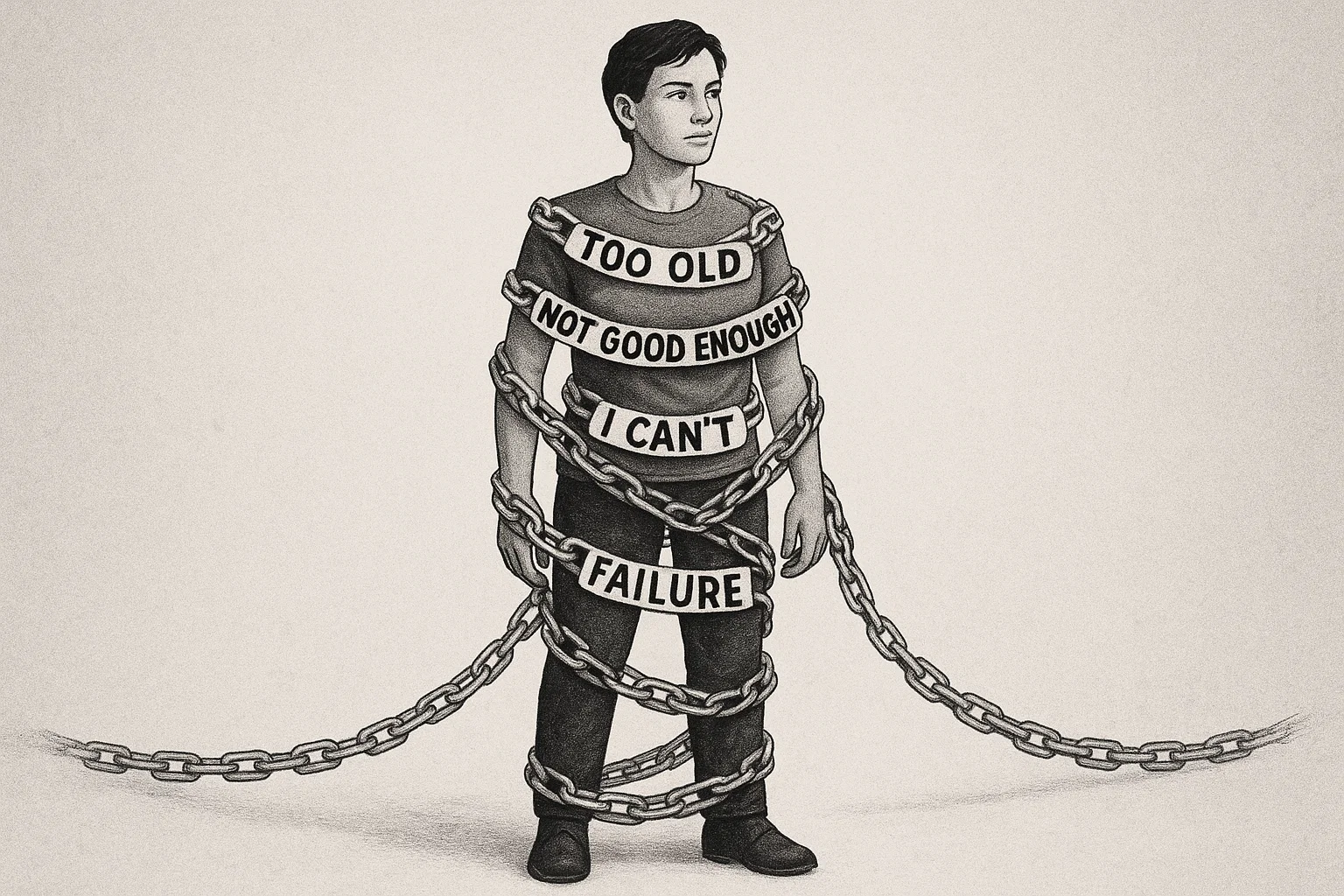
What makes limiting beliefs so persuasive is that they often grow from real experiences. You may have tried and failed once, and the pain of that failure becomes the seed of I am not capable. You may have been told as a child to stop dreaming, and the sting of dismissal hardens into I am not creative. You may have worked in an environment where speaking up was punished, and that memory cements into “better stay quiet”. The story had a purpose at the time, protecting you from risk or disappointment, but when carried forward unquestioned it becomes a cage.
The good news is that beliefs, unlike values, are not fixed. They are learned, and anything learned can be unlearned or rewritten. One way to start loosening them is to notice the language. Limiting beliefs often hide in absolutes like always, never, or I can’t. When you catch yourself saying I always mess this up or I can’t do things like that, pause and ask, is that a fact or a story. Another way is to look for exceptions. If you believe you are not creative, think of one time you solved a problem in a fresh way. If you believe you cannot learn new skills, recall a moment you did, no matter how small. Each exception is like a crack in the wall, proof that the rule is not as solid as it pretends.
It can also help to test beliefs in safe experiments. If you believe you need to have everything perfect before you begin, try sharing something half-finished with someone you trust and notice the response. If you believe asking for help is weakness, try asking one person for a small piece of support and notice how they respond. These small tests gather new evidence, and slowly the weight of experience shifts. You are not pretending a different story. You are showing your nervous system that another way is possible.
The aim is not to eliminate every limiting belief, that would be impossible. The aim is to become aware of them, so they do not run your life unchecked. Once you see them for what they are, you have choice. You can hold onto them if they still serve you, or you can thank them for their protection and set them down. In the space they leave behind, you can adopt more empowering stories, ones that honour your values and expand your world instead of narrowing it.
This piece is the fourth article in a series exploring values and beliefs. In the next instalment I will look at how values shift across life stages, why the things that mattered in your twenties may not be the same as what matters now, and how to realign when life feels out of step with what you care about most.